Love Ladder: How Ghost Leg (Amidakuji) Works, Shown on Stage 26
 Love Ladder The JoyPlus Soft Planning Team
The ghost leg, the ladder lottery known as amidakuji in Japan, has a neat property: however the rungs are drawn, everyone who starts at the top ends up at a different spot at the bottom. Nobody gets lost and no two people land in the same place. Love Ladder is built on that idea. This guide shows why it works, using one real board from the game: Stage 26.
One rung swaps two neighbours
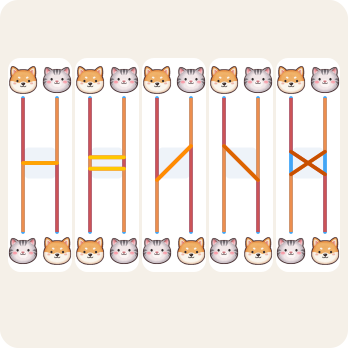
In the classic ladder game a rung is a single bar. An animal walking down meets one end of it, crosses over and keeps walking, and the animal on the other line does the same in the opposite direction. So a rung simply swaps the two animals on its two lines. Love Ladder has five kinds of piece, and four of them do exactly that. The double bar is two rungs in one, so it swaps twice and leaves both animals where they were.
With no pieces, nobody moves
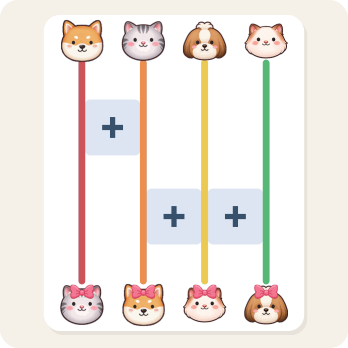
Four animals wait at the top: the Shiba, the grey kitten, the Shih Tzu and the cream cat. Their partners wait at the bottom in a different order: grey kitten, Shiba, cream cat, Shih Tzu. Without pieces the order never changes. Every piece you add swaps neighbours, so the puzzle is to choose the swaps that turn the top order into the bottom one.
Row by row, the order changes
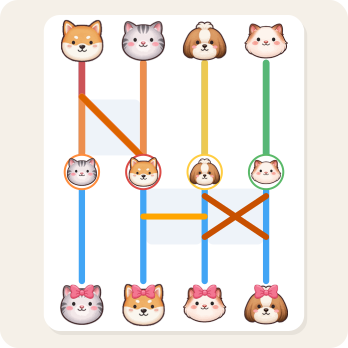
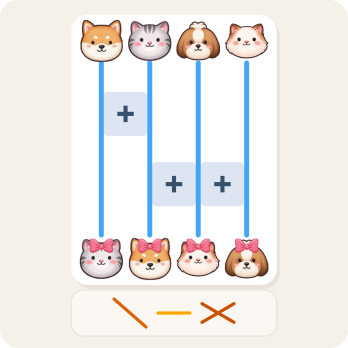
The top row has one slot, between lines 1 and 2, so it can only move those two animals. With the diagonal there, the Shiba and the grey kitten trade places, and the Shih Tzu and the cream cat walk straight through. The grey kitten is now on line 1, right above its partner, and the Shiba is on line 2, right above its own.
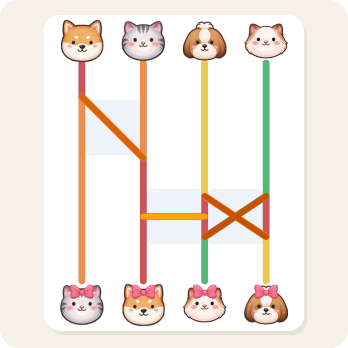
In the bottom row the single bar and the cross touch, so they act as one unit. Follow the Shiba's line: it crosses the bar, goes all the way around the cross, and comes back over the bar to line 2. Meanwhile the Shih Tzu and the cream cat end up swapped. Every animal reaches its partner, and Stage 26 is solved.
Why nobody ever collides
Each piece is a two-way road. Whatever path carries an animal down through it, the same path walked upward leads back to where it started. So if you stand at any spot at the bottom and walk up, you always reach exactly one animal at the top. Two animals can never share a bottom spot, and nobody can be left without one. Row after row, the pieces only ever reorder the animals.
We checked this with a copy of the game's ladder rules: across all 1,000 stages, every one of the 446,011 arrangements the game lets you place sends each animal to a different line.
That is also why Love Ladder can be solved before you press GO: you are only choosing which neighbours swap. The beginner guide shows how to pick those swaps on Stage 37.
The idea in one minute
- A single rung swaps the two animals on its lines.
- A double bar swaps twice, so nothing changes.
- Pieces side by side work as one unit, but they still only reorder the animals.
- Paths can be walked backwards, so every animal always lands on its own spot.
Next guide
Guides for other puzzles