Free to play in your browser — no install, no sign-up.
Crossum
Cross the numbers, solve the sum.
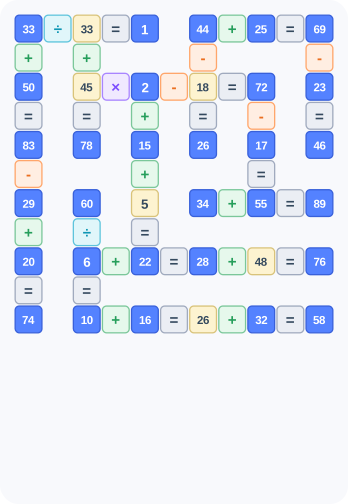
Crossum is a crossword made of equations. Short sums such as 4 + 5 = 9 run across and down the board and share a cell wherever they cross, so every number you place has to work in two equations at once.

Game overview
What is Crossum?
Some numbers are already printed on the board. The rest wait in a tray at the bottom, and your job is to put each one into an empty cell until every equation is true. Easy starts with addition and subtraction on small boards; Normal and Hard use all four operations on 9x9 and 11x11 boards, with longer chains later on.
At a glance
- Tap a number in the tray and then an empty cell, or drag the number straight onto the cell.
- Tap a number you have placed to send it back to the tray.
- Use the crossing equations to work out which number fits where.
- When every equation on the board adds up, the stage is clear.
How a Crossum board works
A Crossum board looks like a small crossword, except every word is an equation. Short sums in the form A + B = C, A x B = C and so on run across and down, and wherever two equations cross they share a cell. The number in that shared cell has to make both equations true at the same time, which is where the logic comes from.
Some numbers are printed on the board from the start. The rest sit in a tray at the bottom of the screen, and there are exactly as many tray numbers as empty cells. A board is solved when every cell is filled, every tray number has been used, and every equation on the board is correct. If you find a different arrangement from the one we had in mind that still makes every equation work, that counts too.
The arithmetic rules
Multiplication and division are worked out before addition and subtraction; otherwise equations are read from left to right, the way you learned at school.
Subtraction never goes below zero, so a result can not be negative.
Division always comes out even. A number that would leave a remainder is never the answer.
Results stay between 1 and 99.
From stage 101 on, longer chains with two operators, like A + B x C = D, start to appear.
Controls
Tap a number in the tray, then tap an empty cell to place it. You can also drag the number straight onto the cell.
Tap a number you already placed to send it back to the tray.
With a tray number selected, tapping a filled cell swaps the two numbers.
Drag a placed number to another cell to move it, or onto a filled cell to trade places.
An equation is checked the moment its last cell is filled. If it is wrong, its cells flash red, you lose one of your three hearts and the number you just placed goes back to the tray. When all hearts are gone you can start the board again, and in the mobile app you can also watch an ad to refill your hearts and keep going.

Difficulties and modes
You can choose between three difficulties. Easy starts on 5 by 5 boards with only addition and subtraction, adds multiplication at stage 10 and moves to 7 by 7 crossword boards from stage 11. Normal plays on 9 by 9 boards and Hard on 11 by 11 boards, both with all four operations. Every board is generated together with a checked solution, and many boards accept more than one correct arrangement, so any placement that makes every equation true clears the board.
The Daily Challenge gives one board per date, the same for every player in the world that day. You can open past dates from the calendar and catch up, and filling every day of a month earns a gold monthly trophy. As you solve, your brain rating climbs from IQ 100 toward 200 through six titles, from Brain Beginner to Einstein Level, and the profile tracks Calculation, Logic and Focus.


Tips for your first boards
An equation with only one empty cell has exactly one answer. Fill it, and that number often unlocks the equation that crosses it.
The answer must be one of the tray numbers. If a sum needs 14 and there is no 14 in the tray, the mistake is somewhere else on the board.
Since division always comes out even and subtraction never goes negative, many tray numbers can be ruled out for a cell straight away.
In a chain like 2 + 3 x 4, the multiplication comes first, so the result is 14, not 20.
A wrong equation costs a heart only when its last cell is filled. If you are unsure, fill the other cells around it first.
Step by step
Guides for Crossum
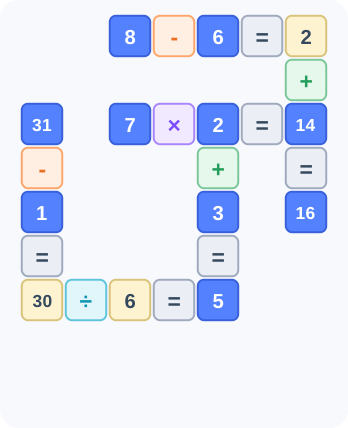
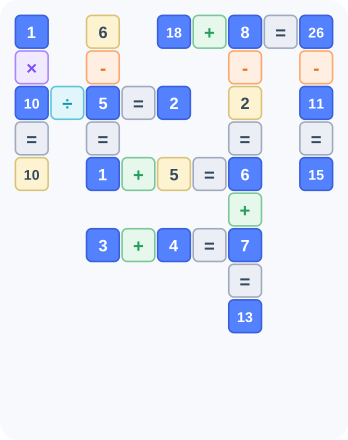
Each guide takes one real board from the game and solves it move by move, with a picture for every step.
Why players come back
Features
- Three difficulties, from 5x5 starter boards to 11x11 grids
- Starts with + and -, then adds x, / and multi-step chains
- Daily challenge and a brain rating that rises as you solve
- Play free in your browser - also on Google Play
Common questions
Frequently asked questions
Is Crossum free?
Yes. You can play in your browser on this page or download it free on Google Play. The Android app shows ads between some stages and offers a single optional purchase that removes ads.
How do hints work?
A hint reveals the correct number for one empty cell. New players start with three hints, unused hints carry over, and in the app you can watch an ad for two more.
Is my progress saved?
Progress is saved on your device first and backed up to our server, so the app keeps working without a connection.
Is there only one correct answer?
Not always. Any arrangement that uses every tray number and makes every equation true is accepted.
Which languages are supported?
The app is available in 14 languages, including English, Korean and Japanese.