Free to play in your browser — no install, no sign-up.
Ten Link
Link numbers that make ten.
Ten Link is a relaxing number-matching puzzle. The board is a grid of digits from 1 to 9, and you clear it two tiles at a time: pick a pair that is either the same number, like 7 and 7, or adds up to 10, like 3 and 7.

Game overview
What is Ten Link?
The trick is what sits between them. Two tiles can only be matched when there is nothing but empty cells between them - in a straight line across, down or diagonally, or in reading order from the end of one row to the start of the next. Clear a whole row and it disappears. Run out of moves and you can add the remaining numbers to the end of the board, but those new rows need clearing too.
At a glance
- Tap two tiles that are equal (7 and 7) or add up to 10 (3 and 7).
- They must face each other across a row, column or diagonal, or follow each other in reading order - only empty cells may sit between them.
- A row that is completely cleared is removed from the board.
- Stuck? Use Add to copy the remaining numbers to the end of the board, or take a hint.
What counts as a pair
The board is nine columns wide and filled with the digits 1 to 9. Two tiles make a pair when they are the same number, like 6 and 6, or when they add up to ten, like 4 and 6 or 1 and 9. Matched tiles are cleared, and the empty cells they leave stay in place.
The real puzzle is getting from one tile to the other. A pair only counts if nothing but empty cells sits between the two tiles, along one of two kinds of path:
A straight line in any of the eight directions: across, down or diagonally.
left to right along a row, then carrying on from the end of that row to the start of the next one, just like reading a page of text.
That means a 3 at the very end of one row and a 7 at the start of the next row are neighbours, and a pair can stretch across a whole stretch of cleared cells. When an entire row is cleared, it disappears and everything below moves up.
Adding numbers and finishing a board
Sooner or later you will run out of pairs. That is what the plus button is for. Pressing ADD copies every number still on the board, in reading order, onto the end of the grid. The new rows open up fresh pairs, but they also have to be cleared. You get six ADDs on your first stages, and the allowance shrinks as stage numbers climb: five from stage 5, four from stage 15 and three from stage 25. A board is finished when every tile is gone. If you have no pairs and no ADDs left, the apps let you watch a short ad for one more ADD, up to twice per board.
Controls
Tap a number to select it, then tap a second number to try the pair.
Tap the selected number again to cancel.
If the second number is not a valid partner, the selection simply moves to it.
If the values match but something is in the way, the tiles that block the path give a little shake so you can see the problem.
You can also drag from one number to the other.
The light bulb gives a hint; the plus button is ADD.
Modes and stages
Ten Link has four difficulties: Easy, Normal, Hard and Expert. They differ in how many tiles the first stage starts with, 18, 30, 42 and 54 respectively, and each new stage adds two more until the board starts with 54. Every difficulty keeps its own stage number, and the stages never run out, so you can stay on Easy for a relaxed session or keep pushing Expert.
The Daily Challenge gives you one board per calendar day. Day 1 of each month starts small and the boards grow through the month, and each month uses a different theme for how the numbers are dealt. You play the days in order, earn a gold star for each, and collect a monthly trophy when the whole month is done. ADDs are not limited in daily boards.
Score Attack opens once you clear stage 5 on Easy. You have 100 seconds on a 9 by 12 board; clearing a board gives a 300 point bonus and deals the next one.
As you play, your brain level rises from 1 to 100, with ten titles along the way. The profile tracks three skills, Calculation, Observation and Focus, and shows how much you played each day of the week.


Tips for your first boards
Many easy pairs hide across line breaks. Check the last number of each row against the first number of the next.
A pair in the middle of a crowded row can open straight lines and reading order paths for several other tiles at once.
A cleared row disappears, which pulls the rows below closer together and creates new vertical and diagonal pairs.
Each ADD makes the board longer. Use one only when you have truly run out of pairs, because the allowance gets smaller on later stages.
1 and 9, 2 and 8, 3 and 7, 4 and 6 and 5 and 5 all work, as do any two equal numbers. When you see a lonely digit, look for both its twin and its partner to ten.
Step by step
Guides for Ten Link
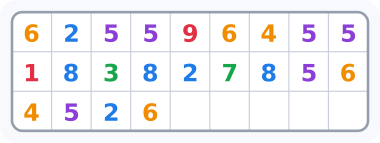
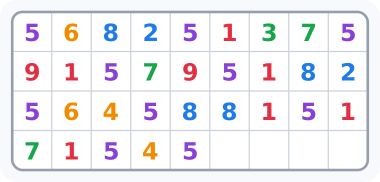
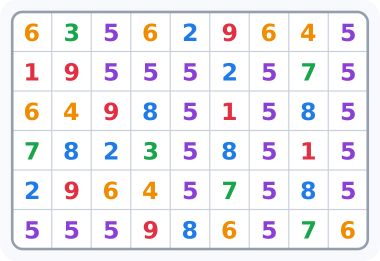
Each guide takes one real board from the game and solves it move by move, with a picture for every step.
Why players come back
Features
- Four difficulties from Easy to Expert
- A new daily challenge every day and monthly trophies
- Brain levels that grow as you clear more boards
- Play free in your browser - also on Google Play
Common questions
Frequently asked questions
Is Ten Link free?
Yes. You can play in your browser on this page, which shows no ads, or download it free on Google Play. The Android app has ads between some stages and optional purchases: ad removal, a starter pack and hint bundles.
How many hints do I get?
New players start with five hints, and hints you do not use carry over. In the app, watching an ad adds two more.
Is my progress saved?
Progress is stored on your device first and backed up to our server, so you can keep playing without a connection. In the browser, clearing site data can disconnect your progress.
Do the stages ever end?
No. Each difficulty keeps generating new stages, with the board size capped at 54 starting tiles.
Which languages are supported?
Ten Link is available in 14 languages, including English, Korean and Japanese.